Languages, Habits & Social Codes

Culture: Customs in Context

Why can a pause in conversation feel welcoming in Jyväskylä, why does a 10:00 a.m. coffee break flatten workplace hierarchies in Gothenburg, and what happens when a Dane orders "breakfast" in Oslo? Understanding everyday etiquette starts with respecting regional distinctions.

Everyday Rituals

What lies beneath the exported buzzwords?

International lifestyle books love turning single Nordic words into self-help remedies. Yet when residents practice these habits at home, they are rarely about purchasing scented candles; they are mechanisms for maintaining social cohesion, workplace fairness, and seasonal endurance.

Sweden Workplace Democracy

Fika as an Information Equalizer

In Swedish offices, factories, and municipal departments, fika is not grabbing an espresso in a paper cup while walking to a train. It is a scheduled fifteen-to-twenty-minute pause—often at 9:30 a.m. and 2:30 p.m.—where the managing director, junior interns, and maintenance staff sit at the same table over filter coffee and cardamom buns (kardemummabullar). Crucial project bottlenecks are often resolved informally because status titles are left at the door.

Flat vector illustration of colleagues sharing filter coffee and cinnamon buns at a long wooden table
Norway Collective Labor

Dugnad and the Spring Courtyard

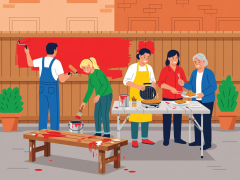
Derived from the Old Norse dugnaðr (help or support), dugnad brings every household in an apartment cooperative (borettslag) or sports club together twice a year to rake leaves, oil communal benches, repaint bicycle sheds, and eat waffles afterward. Opting out without a valid reason is quietly noticed, reinforcing the idea that shared quality of life requires shared sweat.

Flat vector scene of neighbors painting a courtyard fence and serving waffles on a folding table
Finland Acoustic Respect

Sauna Parity and Unhurried Silence

With roughly 3.3 million saunas for 5.6 million inhabitants, the Finnish sauna is a place where business negotiations and boastful titles are set aside. Equally important in Finnish communication is comfort with silence: speaking only when one has something substantive to add is viewed as courtesy toward the listener’s mental space, never as hostility.

Flat vector illustration of a timber sauna dock beside a calm forest lake at twilight
Linguistic False Friends

When does the same word mean the opposite across the border?

Because Danish, Norwegian, and Swedish share vocabulary, travelers often assume every cognate carries the same meaning. In practice, several everyday words have drifted into amusing or confusing territory. Meanwhile, Finland operates as an officially bilingual republic (Finnish and Swedish), where road signs and municipal services in cities like Helsinki/Helsingfors and Turku/Åbo appear in two entirely unrelated language families.

Word Meaning in Danish Meaning in Norwegian Meaning in Swedish
Rolig Calm, quiet, peaceful Calm, steady, quiet Fun, amusing, entertaining
Frokost Lunch (midday meal) Breakfast (morning meal) Frukost = Breakfast
Rar Kind, pleasant, nice Strange, odd, peculiar Sweet, kind, endearing
Grine To laugh out loud To cry or weep Grina = To cry or grimace
Må May (permission) Must (obligation) To feel (health/mood)
The Pronouns of Equality

How did informal "you" reshape public conversation?

Until the late 1960s, addressing a stranger in Sweden required navigating an elaborate web of third-person occupational titles ("Would the Senior Engineer care for coffee?"). In 1967, Bror Rexed, newly appointed director of the National Board of Health and Welfare, welcomed his staff by announcing he would address everyone with the informal singular pronoun du—and expected the same in return.

This rapid shift—known as the du-reformen, mirrored by universal du in Norway and Denmark and sinä in Finland—stripped away verbal deference in classrooms, hospitals, and parliament. Children call schoolteachers and prime ministers by their given names. That linguistic flatness directly shapes how meetings run: an apprentice carpenter is expected to point out a structural flaw in an architect’s drawing without apologizing for speaking up.

Hear From Makers in Conversation